

A Kannada wedding doesn’t announce itself. It’s quiet, prayer-led, and almost always held in daylight, which means the best moments arrive softly and leave just as fast. Miss the half-second when the peacock-feather fan drops, or the exact knot of the Mangalya Dharana, and there’s no second take. Good Kannada wedding photography depends on knowing the ritual order before the priest gets started, not reacting once it’s already happening. This guide walks through every ceremony a Kannadiga wedding moves through, the specific shots a photographer must come away with, and the lighting and timing decisions that make or break the day.
What Makes Kannada Wedding Photography Different
Kannada (Kannadiga) wedding photography is the documentation of Karnataka’s traditional Hindu wedding rituals — from Nischay Tamulam to Saptapadi — captured in a candid, daylight, family-led style rather than a stage-managed one. Most Kannada weddings run one to two days and take place during the morning, around an auspicious muhurtha. That single fact reshapes everything: you’re working with natural light, tight indoor mandaps, and a mood that’s reverent instead of theatrical.
Compared to a North Indian wedding, the contrast is sharp. There’s no late-night sangeet spectacle to light up, no baraat with a DJ truck. A Kannadiga wedding is “traditional without being loud” — built around prayer, family, and a handful of deeply emotional handovers. So the photographer’s job leans documentary, which is why a candid rather than purely traditional approach tends to suit it best. You’re watching for genuine reactions, not building them. The visual signatures to frame for are consistent: crisp Mysore silk sarees, layered gold jewellery, flowers in the hair, banana-leaf feasts, and that peacock-feather fan during the bride’s entry. (If you’re still deciding how much coverage you want, our overview of the different types of wedding photography is a useful starting point.)
Pre-Wedding Rituals & The Shots to Capture
The lead-up rituals are intimate and home-based. They set the relationships you’ll be photographing for the next two days, so treat them as more than warm-up.
Nischay Tamulam (Engagement)
This is the formal engagement, held once the horoscopes match. Both families exchange platters of betel leaves, betel nuts, coconut, fruit, and sweets, and the priest fixes the wedding date. Your must-have shots: the platter exchange mid-gesture, the bride receiving her saree and sweets from the groom’s parents, and the wide frame of both families together. Don’t forget the elders’ faces during the blessings — that’s where the emotion sits. For couples who want a separate styled session around this, our engagement photoshoot poses for couples gives plenty of direction.
Naandi & Bale Shastra
A few days before the wedding, the Naandi puja happens at both homes to clear obstacles before the celebrations begin. Look for the copper kalash topped with a coconut, the priest’s hands during the ritual, and the bangle and turmeric moments with the bride and her relatives. If the family holds a haldi ceremony or a mehndi sitting around the same time, plan those as their own detail-and-candid sets — shoot tight on hands, thread, flowers, and the small exchanges happening at the edges of the room.
Kaashi Yaatre
This is the ritual most outside photographers don’t see coming, and it’s pure gold. The groom pretends to give up on married life and sets off “to Kashi” with an umbrella, a walking stick, and a few essentials — until his maternal uncle talks him back. It’s funny, fast, and full of real laughter. Shoot it as a sequence: the mock departure, the family’s reactions, the moment he’s coaxed home. Burst mode helps; the punchlines don’t wait.
Wedding-Day Rituals: The Must-Capture Moments

This is the heart of the day, and the sequence is fairly predictable: Mandap Puja, the groom’s welcome, Var Puja, Jaimala, Dhare Herdu, Mangalya Dharana, and Saptapadi. Know it cold so you’re always one ritual ahead. The shot discipline here mirrors what we cover in our guide to Hindu wedding photography, adapted for Kannadiga customs.
Var Puja & Groom’s Welcome
In Kannada tradition the groom is received as an incarnation of Lord Vishnu. The bride’s father washes his feet and presents him with a silk vesti and angavastram, which the groom then wears for the ceremony. Capture the feet-washing from a low angle, the gifting of the vesti, and a clean wide of the welcome at the mandap entrance with the five married women performing aarti.
Bride’s Entry (Peacock-Feather Fan)
The bride enters with her face hidden behind a peacock-feather fan, and a cloth screen is held between the couple so they can’t see each other yet. The drop of that screen is the hero shot of the entire wedding. Pre-focus, lock your exposure for the bride’s face, and be ready — when the screen comes down, you have one frame of that first look. Get it.
Jaimala (Garland Exchange)
The couple exchange garlands. The trick is timing the lift so both faces are visible and the garland isn’t covering anyone’s expression. Shoot from a slight angle rather than dead-on, and take the burst — the playful struggle to reach over is often the best frame.
Dhare Herdu (Giving Away)
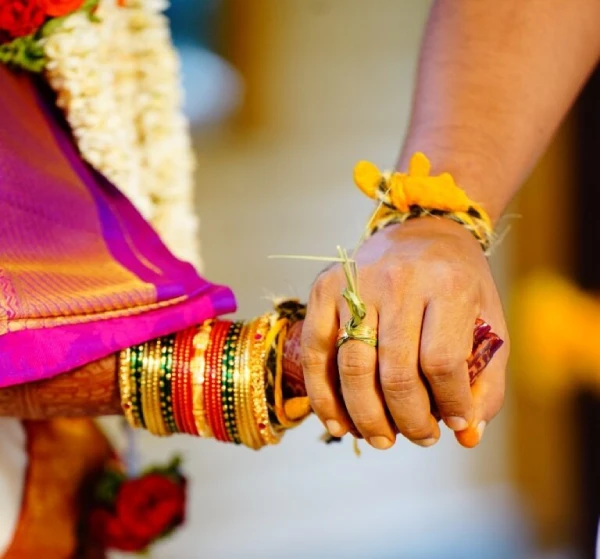
This is the Kannada equivalent of kanyadaan, the giving away of the bride’s hand. It’s the emotional peak for the parents. Frame the joined hands of the couple with the father’s hands over them, then pull a second frame for the parents’ faces. One is the literal moment; the other is the feeling.
Mangalya Dharana (Thali Tying)
The groom ties the mangalya (thali) around the bride’s neck in three knots, sealing the marriage. Shoot tight and shoot fast — the knots happen quickly and the bride’s expression in that instant is the single most important portrait of the day. This is also the moment to set up the bridal portraits you’ll want right after the ceremony, while she’s still in full ceremonial jewellery.
Saptapadi (Seven Steps Around Fire)
The couple circle the sacred fire seven times, reciting their vows. This is your low-light ritual: warm fire glow, dim mandap, lots of movement. Drop your shutter only as far as the motion allows, lean on the fire as a light source, and look for the silhouettes and the glow on their faces as they walk.
Post-Wedding: Gruha Pravesha & Reception
When the bride reaches the groom’s home, Gruha Pravesha welcomes her in. She lightly kicks a pot of rice at the threshold — prosperity flowing into the house — and in some families presses turmeric handprints onto the wall. Both are quick and symbolic, so position yourself at the doorway in advance. The reception that follows shifts the day from daylight to evening, so reset your lighting plan, lock down the family group-shot logistics early, and keep portraits moving before guests tire.
Lighting, Timeline & Logistics for a Kannada Wedding (2026)
Most Kannada weddings hinge on an early-morning muhurtha, which is a blessing and a problem. The blessing is soft window light during the rituals. The problem is the jump from a dim mandap to harsh midday sun for the post-ceremony portraits — plan your exposure changes ahead of each transition.
For a one-to-two-day Kannada wedding, a single photographer can cover a small ceremony, but two shooters are strongly recommended — one stays locked on the couple at the mandap while the second covers family reactions, the Kaashi Yaatre laughter, and the wide context shots you’d otherwise lose. On style, candid documentary coverage suits a family-led ceremony better than heavy posing, though most couples want a blend of candid storytelling and a set of traditional portraits. Book early: in Bangalore, in-demand photographers fill peak-season muhurtha dates months ahead, so it pays to start choosing your wedding photographer well before the season.
Frequently Asked Questions
What are the main rituals in a Kannada wedding to photograph?
The core sequence runs Nischay Tamulam (engagement), Naandi, Kaashi Yaatre, then the wedding-day rituals: Var Puja, the bride’s peacock-feather-fan entry, Jaimala, Dhare Herdu, Mangalya Dharana, and Saptapadi — closing with Gruha Pravesha and the reception.
How is Kannada wedding photography different from other South Indian weddings?
Kannada weddings are typically shorter, held in daylight, and more prayer-led and family-led than performance-led. That pushes the photographer toward natural-light, candid documentary coverage rather than stage-lit, heavily posed shooting. The contrast is clearer when you compare it with how a Muslim wedding or a Christian wedding is photographed.
How many photographers do I need for a Kannada wedding?
One can handle an intimate ceremony, but two is the safer choice. A second shooter captures family reactions and wide context while the lead stays on the couple through the fast, unrepeatable rituals like Mangalya Dharana.
What is the most important moment to capture?
The Mangalya Dharana (thali tying) and the Dhare Herdu (giving away). One seals the marriage; the other holds the day’s deepest emotion. Both happen fast, so both demand burst mode and full attention.
How much does a Kannada wedding photographer in Bangalore cost?
Pricing depends on coverage days, team size, and deliverables like albums and film. Our photographer cost guide for Bangalore breaks down what each tier includes so you can budget realistically.
The Takeaway
Strong Kannada wedding photography comes down to one thing: knowing the rituals before they unfold. The ceremonies are gentle and quick, the light is daytime and unforgiving in turns, and the most moving moments — the fan dropping, the three knots, the father’s hands — give you a single chance each. A photographer who has shot Kannadiga weddings reads the room a beat ahead and is already in position when it matters.
Why Sidphoto
Sidphoto is a Bangalore-based wedding photography studio experienced with Kannada and other South Indian ceremonies, offering both candid documentary coverage and traditional portraits. We know the ritual sequence, plan for the daylight-to-evening lighting shift, and staff weddings to catch the moments that get missed. See why couples rate us among the best wedding photographers in Bangalore, or request a quote for your date.